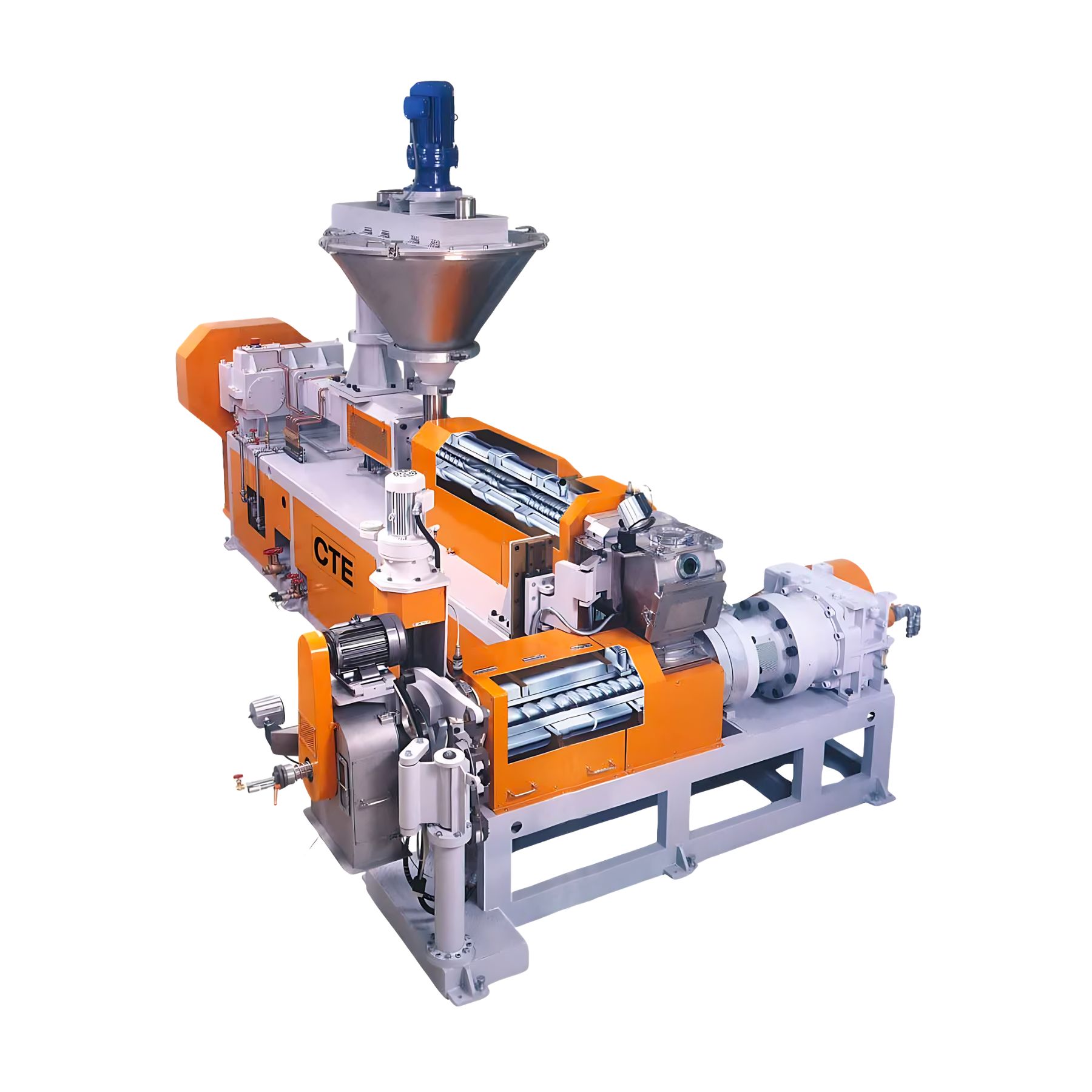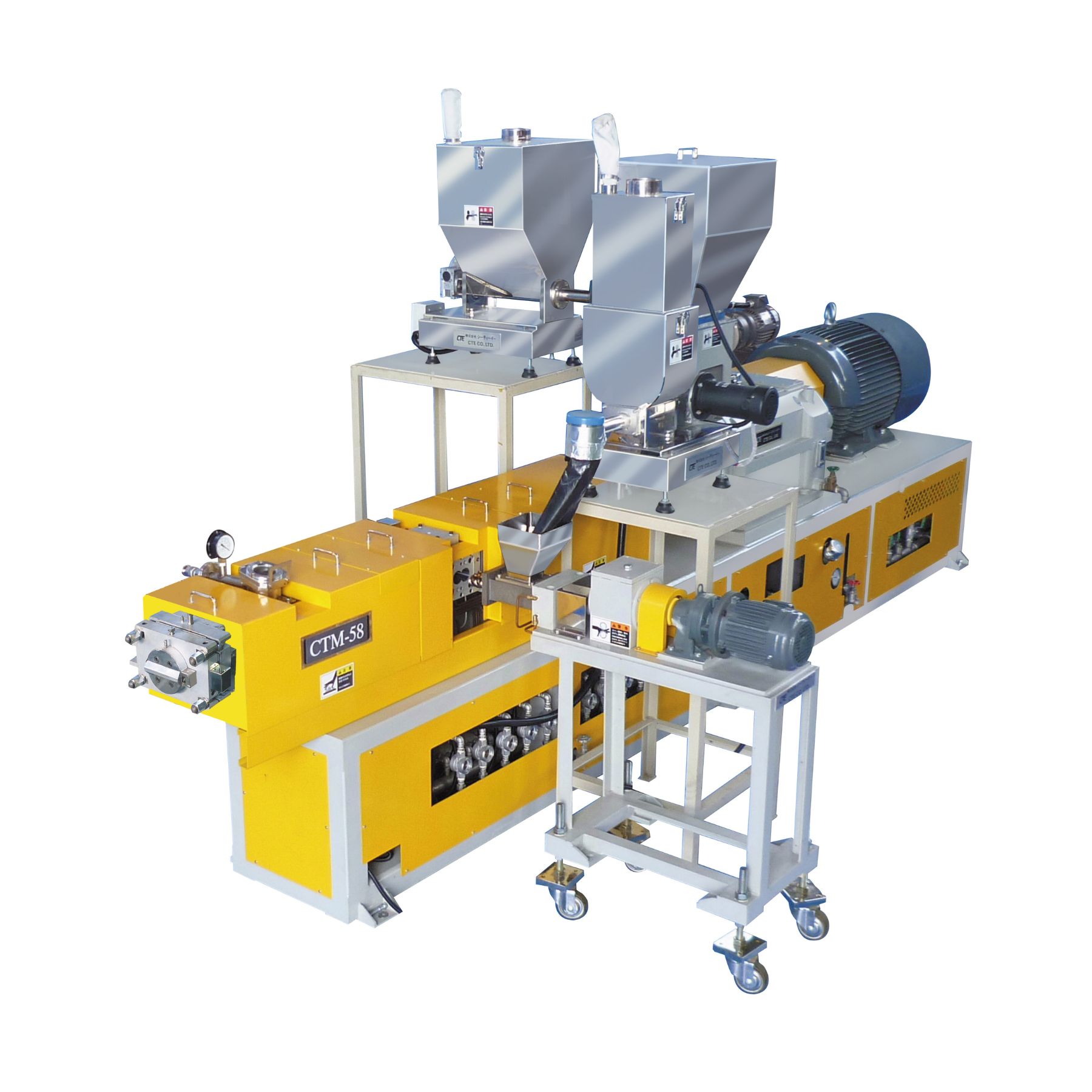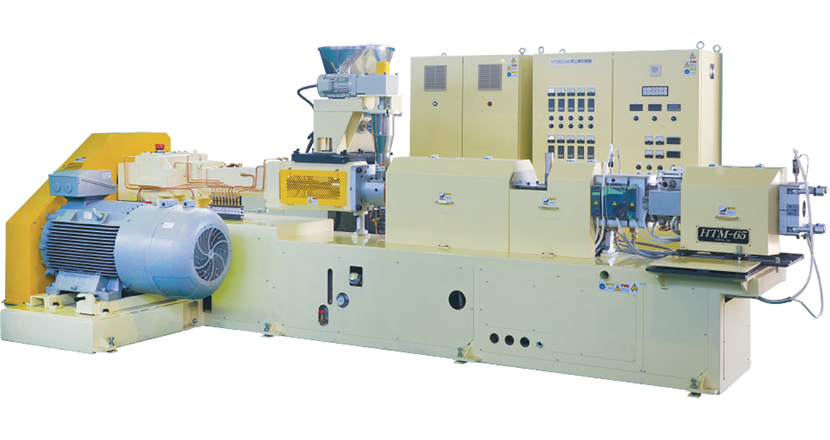
Understanding the basic features and applications of twin-screw extruders is an important decision factor in selecting equipment and designing products. Especially in cases where composite materials or additives are used, it is important to have sufficient knowledge before introducing the machine because its high kneading performance directly affects product quality.
A twin-screw extruder is a device that kneads raw materials while heating them and continuously extrudes and forms them. By using two screws in a cylinder, multiple materials can be homogeneously dispersed and mixed. Compared to single-axis extruders,It features excellent kneading and processing capabilities.Screws can be changed according to the purpose. The screw configuration can be changed according to the purpose. As a result, the range of materials that can be handled is wide and can meet diverse needs from engineering plastics to biomass resins.
| use | Features and Support |
|---|---|
| Extrusion molding of plastic products | Suitable for continuous forming of pipes, sheets, films, profiles, cable sheathing, etc. Suitable for processing high-viscosity resins, and its high kneadability contributes to improved dimensional stability and surface quality. |
| Polymer compound/masterbatch manufacturing | Uniform mixing of additives and fillers is possible. Various functional materials such as glass fiber, flame retardants, and high filler materials are also supported. |
| Recycled applications | Effective for re-pelletizing crushed materials and used resins. Devolatilization performance and low-temperature extrusion prevent deterioration of physical properties and appearance. |
| food processing | Utilized in the production of cereals, snacks, pasta, pet food, etc. Integrated processing from starch pasteurization to molding. |
| Processing of pharmaceutical and cosmetic raw materials | Granulation and encapsulation of pharmaceutical and cosmetic ingredients. Suitable for applications requiring homogeneous formulations. |
| High Performance Materials & Composites | Supports composite CNF and WPC. Even complex formulations are kneaded uniformly, contributing to improved performance. |
Twin-screw extruders are used in diverse fields due to their high mixing and processing capabilities. For example, in the automotive industry, they are utilized for extrusion of TPE, TPV, and flame retardant materials, contributing to improved heat and impact resistance. In food packaging, PLA and CNF can be combined to produce environmentally friendly containers.
It is also used in resin films such as BOPP and BOPET in the optical field, achieving high transparency and a balance of physical properties. It is also used in building materials such as foamed PE and XPS boards, and recycled materials such as PET and PE, etc,Twin Screw Extruders are used in a wide range of applications.
Twin-screw extruders offer the following advantages
High kneading performance enables appropriate control of shear force and residence time,Enables uniform kneading of raw materials even in complex formulationsThe system is also capable of handling a wide range of materials. In addition, multiple processes such as devolatilization, reaction, and granulation can be completed on a single line, contributing to overall process efficiency.
Another feature of this machine is its flexibility to handle a wide variety of material shapes, such as powders and liquids, as well as pellets. The screw configuration and temperature profile can be adjusted according to material characteristics, providing a high degree of customizability to meet product specifications and development requirements.
CTE's twin-screw extruders combine high mixing, dispersing, and degassing performance,Compatible with complex compounded materials, recycled materials, and high filler compoundsThe flexibility of this product is its ability to be used in a wide range of applications. It is suitable for sites where both quality and productivity are required, as it ensures stable physical properties while minimizing burns and agglomerations.
It is also directly linked to reduction of material loss and review of raw material costs, and contributes to improvement of the profit structure of the entire production line. When considering the introduction of a twin-screw extruder, please consider CTE, which is backed by our proven track record and technical capabilities.
The parallel type has two screws of the same diameter arranged in parallel and is widely used among twin-screw extruders. This type is widely used among twin-screw extruders and can handle high torque and high throughput,mass productionSuitable for The high degree of freedom in screw configuration allows for versatility in flexibly accommodating a wide range of materials by changing the configuration.
The unidirectional rotation type has a structure in which two screws rotate in opposite directions and is mainly suited for applications that require high degassing performance and suppression of shear heat generation. Combined with a non-intermeshing structure where the screws do not interlock, while preventing material retention,Excellent balance of kneadability, degassing, and low-temperature extrudabilityType. A type that performs well with recycled materials, highly filled materials, and processing of heat-sensitive materials.
The conical type features a conical shape with the screw tapering toward the tip. It has excellent pressure stability and conveying performance, Processing of PVC and other heat-sensitive materialsSuitable for Due to the shape of the shaft, there is not the same degree of freedom in screw configuration as with the parallel type. However, the structure allows for a narrower distance between the shafts, making it possible to downsize the equipment more compactly than the parallel type.
In the twin-screw extruder, two screws rotate in the same or opposite direction under power supplied by a motor, conveying the raw material whileShearing, mixing, plasticizingThe screw is modularly configured so that it can be freely reassembled according to the application and purpose. Screws are modularly constructed and can be freely reconfigured to suit the application and purpose.
A barrel is a cylindrical transport channel that houses two screws. It is divided into several zones,Stepwise control of temperature and pressure at eachThe An appropriate temperature profile ensures stable extrusion while preventing decomposition and degradation of the raw material.
The twin-screw extruder efficiently removes moisture, volatile components, and gases from the raw materials.vent zoneis provided. When raw materials pass through the vent zone, devolatilization and degassing prevent product quality deterioration and ensure stable processing.
In addition to its ability to handle a wide variety of materials, the twin-screw extruder combines high-precision kneading performance with excellent pressure-feeding capability. In addition, the twin-screw extruder can handle multiple processes such as reaction, devolatilization, and drying in a single unit, thus offering the advantage of process integration,Production efficiency can be improved and equipment simplified.The company's products are used in a wide range of industries. These features directly lead to stabilization of product quality and improvement of yield, and are the reasons why our products are chosen by a wide range of industries.