
All you need to know about twin screw extruders│Twin Screw Hub " Improvement Measures for a Profitable Plastic Processing Plant " Review of raw material costs for plastics
Review of raw material costs for plastics
This site is operated by Zenken Corporation with CTE Corporation as a sponsor.
Table of Contents
Show all items
In plastic manufacturing, the cost of raw materials has a significant impact on overall manufacturing costs. In recent years, prices have continued to soar, and it is becoming increasingly difficult to secure profits with a system that relies on purchasing. Now is the time to review the use of raw materials themselves and change the profit structure from the manufacturing site.
Reviewing raw material costs changes profit margins.
In plastics manufacturing, it is not uncommon for raw material costs to account for more than 50% of total manufacturing costs. Therefore, even a cost improvement of only 10 yen per kg,Profit improvement of several million yen per year can be expected..
For example, if the annual usage is 500 tons, an improvement of 10 yen will directly lead to a cost reduction of 5 million yen. Reviewing daily costs is an important management decision that greatly affects profit margins.
Current situation of rising raw material costs and structural problems
In recent years, the cost of plastic raw materials has remained high. This is due to a complex mix of external factors, including naphtha price fluctuations resulting from soaring crude oil prices, rising international transportation costs, and unstable exchange rates.
For companies with a strong dependence on virgin materials and outsourced compounds, the impact of such raw material cost increases is immeasurable. Since it is difficult to gain the understanding of suppliers, it is also difficult to pass on the cost of raw materials to customers, resulting in a structural problem that puts pressure on profits. In a situation of "just purchasing raw materials and using them,Difficult to control costs in-houseand strategic improvements will be difficult to achieve.
Common examples of wasteful structures
At manufacturing sites, there are many cases where raw materials are not used properly, resulting in losses. For example, inability to make good use of recycled materials results in waste or lost products, and poor yields result in extra costs.
AnotheUnstable formulation of fillers and additives, causing quality problemsIn some cases, the cost of collection and reimbursement cannot be overlooked. If a complaint develops, the costs associated with recovery and reimbursement cannot be overlooked. In addition, there are some sites where additives are put in more than necessary and proper cost control is not achieved. All of these factors put pressure on the cost of raw materials for plastics and require immediate improvement.
Redesigning raw materials to solve the problem
The breakthrough for profit improvement lies in reviewing the use of raw materials themselves. For example,In-house system for kneading and dispersionby preparing for the redesign and reuse of purchased raw materials as a resource.
Specific measures include cost compression through active use of recycled materials and high filler content, and quality stabilization through kneading and degassing using twin-screw extruders. Furthermore, switching from outsourcing to in-house design of material formulations will make it possible to achieve both cost and quality.
Below are details on the raw material cost improvements that can be realized with twin-screw extruders.
Material Strategies Enabled by Twin Screw Extruders
Twin-screw extruders are capable of performing a series of processes such as heating, shearing, kneading, and degassing, and are suitable for kneading raw materials to homogeneity. It has high kneading performance and dispersibility, enabling the use of low-cost materials and recycled materials that have been difficult to use in the past.
In recent years, improvements in operability have made it possible for even small-scale, small-group factories to operate without difficulty, encouraging in-house production and independence in materials strategy.
Introducing CTE's twin-screw extruder, a powerful tool for reviewing raw material costs
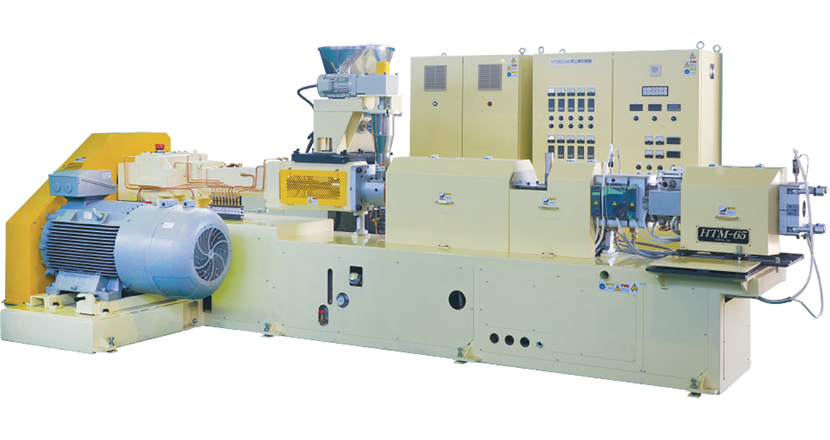
Citation: CTE Official
https://cte-japan.com/en/product/htm-twin-screw-extruder/
https://cte-japan.com/en/product/htm-twin-screw-extruder/
HTM Twin-Screw Kneading Extruder
Uniform dispersion is achieved while efficiently degassing air and generated gases contained in high filler materials. This allows stable use of inexpensive materials such as wood powder and regrind materials without burning or color irregularities.
For example, wood flour that has not been pre-dried can be converted directly into pellets. In addition to the reduction of equipment and energy costs by omitting the drying process,Increased freedom of raw materialsThis will also help to optimize overall material costs.
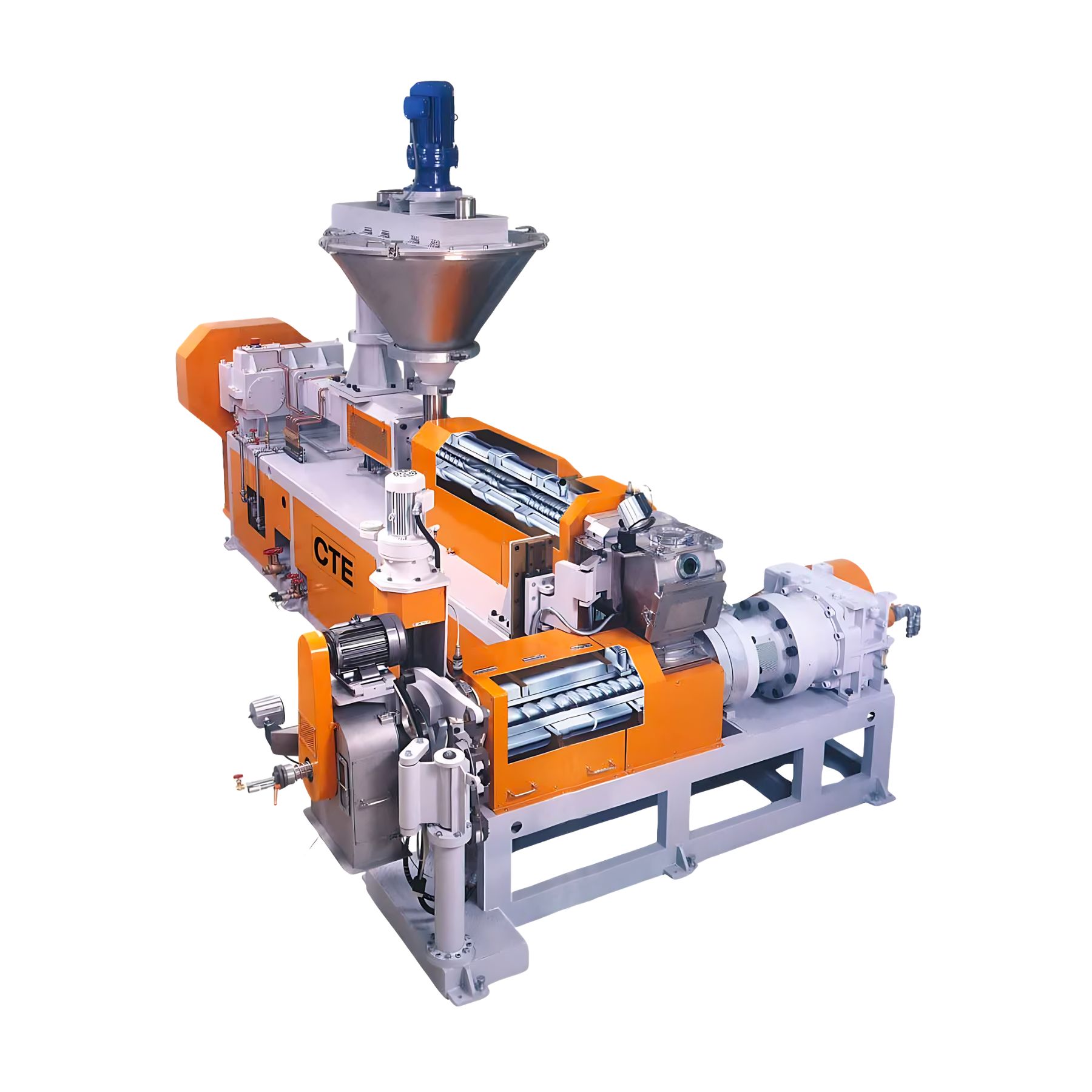
Citation: CTE Official
https://cte-japan.com/en/product/htm-tandem-compounding-twin-screw-extruder/
https://cte-japan.com/en/product/htm-tandem-compounding-twin-screw-extruder/
HTM type tandem kneading extruder
High kneading and degassing performance ensures stable extrusion and pellet quality while increasing the use ratio of recycled and high filler materials.
Unique to recycled plasticsBecause water and gas components can be efficiently removed, physical property deterioration and burning are prevented even for recycled materials of unstable quality.and can be used effectively as a material.
This equipment expands the choice of available raw materials at sites such as chemical recycling, material recycling, and biomass kneading, resulting in optimization of raw material costs.
What CTE twin-screw extruders can achieve
- Degradation of physical properties is noticeable in materials with thermal history, such as recycled materials.
→ with re-pellets of recycled materials,Reduced deterioration compared to meshing co-directional biaxial - Insufficient pre-drying causes quality deterioration.
→ PC (polycarbonate)Pre-drying time can be reduced to 1/3 with no problem.Extrusion molding is realized
→ With the installation of vacuum vents.No pre-dryingExtrusion molding is now possible with - Trying to use biomass materials, but the quality deteriorates when blended.
→Biodegradable resins such as PLA and PBAT mixed with fillerExtrusion without quality deterioration
→directional marker or indicatorBiomass materials such as wood flour and starchand resin can be extruded without burning the material.
Data showing performance of CTE products
Comparison of throughput
Stable molding even with high filler content
The graph below compares the throughput per screw diameter between HTM (unmeshed) and CTM (meshed).
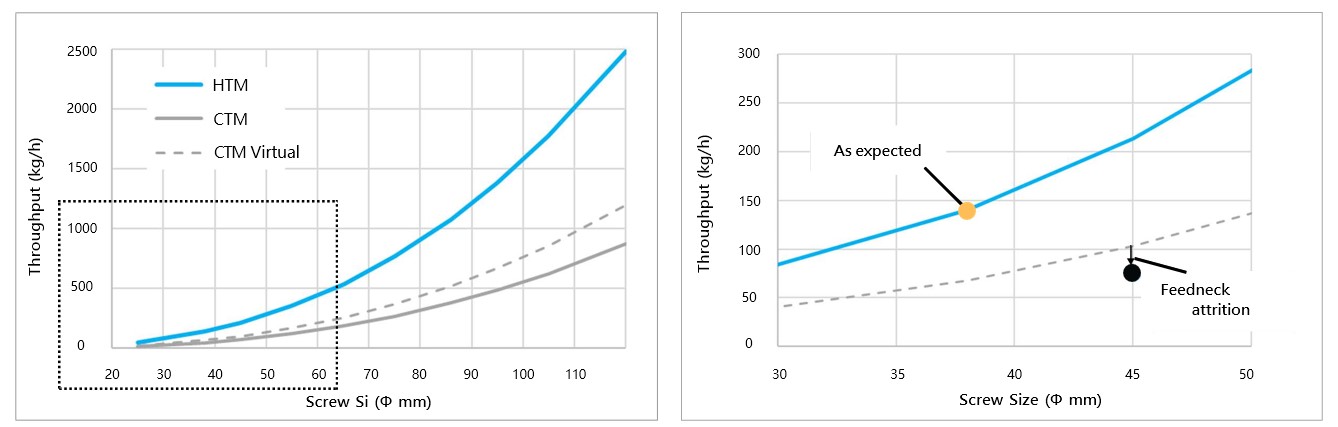
*Data provided by CTE
CTE's HTM extruder (blue line) achieves higher throughput in the same size compared to the conventional CTM (gray and dotted lines) with the same direction and intermeshing structure. In particular, the enlarged image on the right side shows that the HTM machine maintains stable throughput due to smooth material feeding while the CTM machine suffers from feed-neck phenomenon (material clogging).
With this stability and throughput,Easier to actively use low-cost recycled materials and by-products, rather than relying on virgin materials.It will be.
summary
Increasing the range of available raw materials leads to cost review
As the cost of raw materials continues to rise, it is becoming increasingly difficult to protect profits with the same procurement and use as before. With price negotiations and purchasing route innovations alone reaching their limits, a drastic measure that can be taken on the frontlines is to shift to a policy of how to utilize raw materials.
CTE's twin-screw extruders are used to produce recycled and high filler materials, includingEquipment that can utilize a wide range of raw materials in a stable manner while maintaining qualityIt is. We support the optimization of manufacturing costs from the field by enabling stable molding of low-cost materials while minimizing burnout and deterioration.